
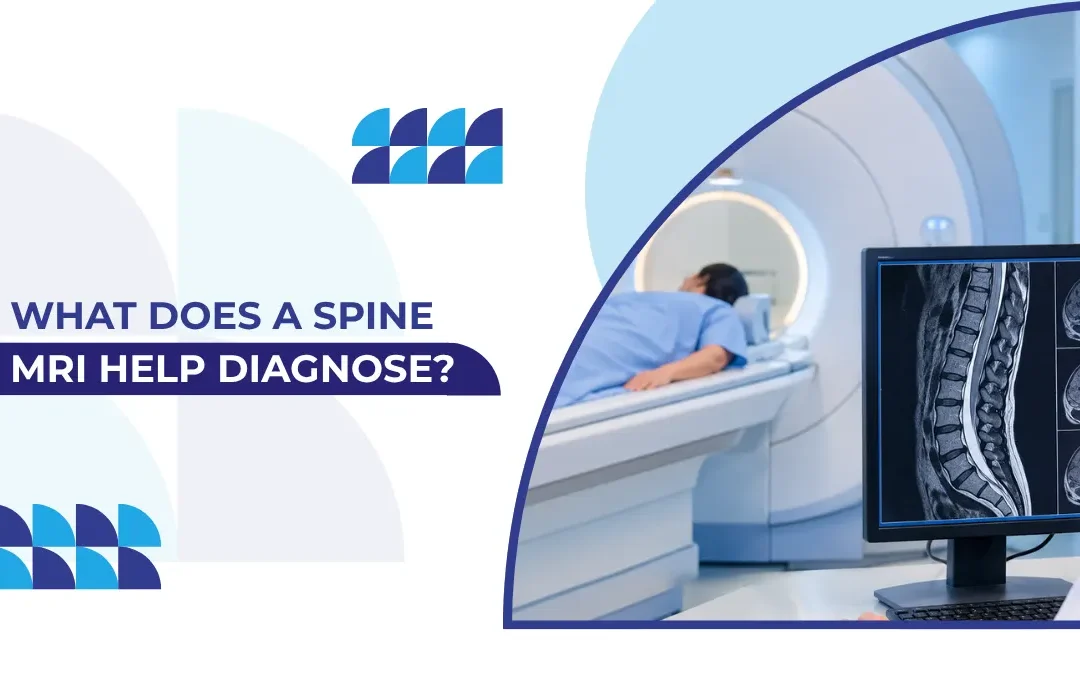
Pain that shoots down one leg or a neck that won’t loosen up usually sends people looking for answers about their spine. A spine MRI scan can supply some. When an X-ray comes back clean, this is often the scan that finds the slipped disc, the pinched nerve, an infection or a tumour, because it shows the vertebrae, the cord and the tissue around them together.
According to the senior radiologist at Echelon Hospital, a multi-specialty hospital in Navi Mumbai, “Bone is easy to see on an X-ray. Discs and nerves are not. On an MRI we can follow a nerve out of the spinal canal and see whether something is pressing on it. That is usually the missing piece when the symptoms don’t match the X-ray.”
What Does a Spine MRI Scan Show?
The images come as thin slices from the side and from above, so each level of the spine can be looked at from two angles. Nothing in the process uses radiation.
Discs: Water content is the giveaway. A young disc is full of it and looks bright. By middle age many have dried out, gone dark and flattened, and a bulge toward the nerves stands out.
Spinal cord and nerve roots: Is the canal wide enough? Can each nerve leave it freely? Radiologists look at both. A swollen stretch of cord or an odd patch inside it would show here too.
Vertebrae and joints: Compression fractures, arthritis in the small facet joints and marrow changes inside the bone are all visible.
Surrounding soft tissue: Ligaments and muscle are clear on the images. Inflammation or fluid gathering around the spine is as well.
Most people find the lying still in a loud, narrow scanner harder than the test itself. Reading about how an MRI scan works beforehand makes that part feel far more manageable.
Shooting back pain? Enquire to find out if you need an MRI.
Which Conditions Does MRI Diagnosis Help Confirm?
An MRI usually comes after the examination and sometimes an X-ray have failed to explain what is going on. Some diagnoses turn up far more than others.
Disc herniation: Sciatica is the classic result. Pain starts in the buttock and travels down the back of the leg.
Spinal stenosis: The canal narrows over the years and the nerves get crowded. People often notice it when they walk, since walking tends to bring it on.
Infection and inflammation: A scan of an infected disc or vertebra looks quite unlike one that has simply worn down. Ankylosing spondylitis and similar inflammatory conditions leave a pattern of their own.
Tumours and injury: Growths inside or outside the cord can be found. After an accident the scan shows whether the cord or ligaments were hurt.
Discs are behind most scans, and the warning signs are worth knowing. This guide to slipped disc symptoms covers them.
How Are Spine MRI Results Read?
A radiologist reviews every slice and writes up what they see. The report on its own isn’t a diagnosis, and it is read together with the person’s symptoms and examination.
Normal scan: No compression or damage. Should the pain carry on regardless, the muscles or something outside the spine may be the source.
Incidental findings: Plenty of adults with no pain at all have mild disc bulges and wear on their scans. A finding like that can be real without being the cause of the complaint.
Contrast scans: For suspected infection or tumour a dye called gadolinium may be injected. It isn’t part of most routine back scans.
Next steps: Some results lead to a repeat scan or further tests. Plenty simply lead to a treatment plan.
The scan helps guide treatment, but it doesn’t determine it. Surgery is rarely the first step, and in serious cases spine surgery is usually considered only once non-surgical options have been tried.
Key Takeaways: A spine MRI shows discs, nerves, the cord and surrounding tissue without using radiation. It helps detect disc problems, stenosis, infection, tumours and injury. Its findings only count when they line up with symptoms. Many people have changes on a scan without any symptoms.
FAQ
How long does a spine MRI take?
Most scans run 20 to 45 minutes. Each extra region adds time.
Is a spine MRI safe?
It involves no radiation. If you have a pacemaker or another implant, tell the staff first. Some devices can’t go near the magnet.
Do you need to fast for a spine MRI?
Usually not. It only comes up when contrast is planned, and the staff will say so.
What is the difference between a spine MRI and a CT scan?
MRI is the better choice for discs, nerves and the cord. CT is sharper for fine bone detail.
References
- NIBIB, Magnetic Resonance Imaging (MRI): https://www.nibib.nih.gov/science-education/science-topics/magnetic-resonance-imaging-mri
- RadiologyInfo.org (RSNA and ACR), Spine MRI: https://www.radiologyinfo.org/en/info/spinemr
Disclaimer: This blog is for educational and informational purposes only and should not be considered professional advice.