
Keyhole surgery gets marketed on tiny cuts and a quick bounce-back, and most people do get exactly that. But tiny isn’t the same as sealed shut for good. Each port is still a hole cut through muscle. And a hole that doesn’t close the way it should can reopen, sometimes months down the line, sometimes years.
Now, the reassuring bit. This happens far less than after open surgery, and when it does, it’s usually straightforward to fix. Somewhere between under 1% and about 5% of laparoscopic patients run into it. Compare that to as high as 20% after a traditional open incision. About half turn up in year one. The other half take their own sweet time.
Almost everything we see is small, caught early, and easy to manage. If I could tell patients one thing, it’d be this: don’t brush off a new bump or an odd pulling feeling at an old port site, even if the surgery was years ago.
General Surgery Team, Echelon Hospital, Navi Mumbai
What Is an Incisional Hernia?
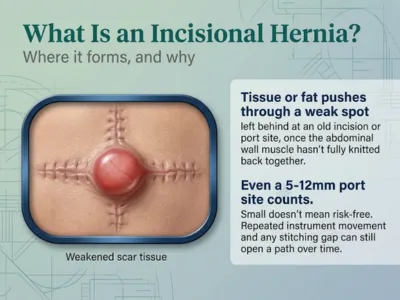
Fat, or occasionally a bit of bowel, works its way through a weak spot at an old incision. The skin on top looks completely normal, scar and all. It’s the layer underneath that’s the problem, the muscle and fascia never quite grew back together the way they should have.
A lot of people figure a 10mm port is too small to cause trouble. It isn’t. It goes through the exact same layers a much bigger cut does, just on a smaller scale. Close it slightly loose, or let healing go slightly wrong, and it opens a gap all the same.
Laparoscopic Surgeries That Can Lead to Incisional Hernia
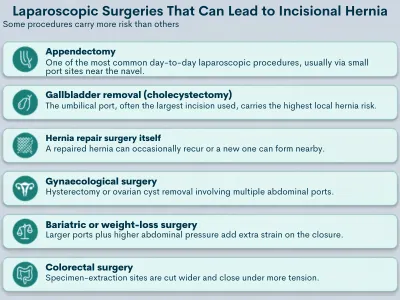
- Routine, generally low risk, though not risk-free.
- Gallbladder removal (cholecystectomy). The umbilical port is often the widest cut used here, and the numbers reflect that.
- Hernia repair surgery. A repaired hernia can recur, or a fresh one can pop up next to the mesh.
- Gynaecological surgery, hysterectomy, ovarian cyst removal. More ports means more chances.
- Bariatric or weight loss surgery. Bigger ports and higher abdominal pressure don’t mix well.
- Colorectal surgery. Extraction sites tend to be cut wider and close under real tension.
Causes and Risk Factors
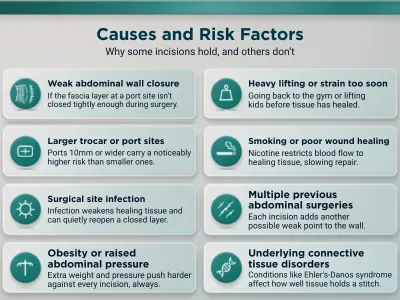
Boil it down and it’s the same story every time. Either the muscle layer wasn’t closed tightly enough, or it was closed fine and something after the fact pulled it back open. What tips the scale is different for everyone.
- A closure that wasn’t quite tight enough to begin with
- Larger trocar or port sites, 10mm and above
- An infection at the surgical site
- Obesity, or just ongoing high abdominal pressure
- Jumping back into heavy lifting too soon
- Smoking, no way around it, it slows healing down
- A history of several abdominal surgeries
- Connective tissue disorders, Ehlers-Danlos being one example
Symptoms of an Incisional Hernia
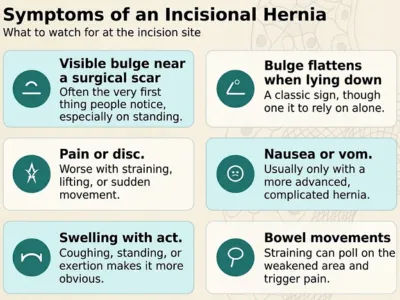
- A bulge near an old scar or port site, the giveaway sign for most people
- Pain right at the spot, especially when you strain or lift something
- Swelling that’s more obvious standing up, coughing, or moving around
- A bulge that flattens or disappears once you lie down
- Nausea or vomiting, though this usually only comes up once things have progressed
- Discomfort during a bowel movement, or after a hard workout
How Soon Can an Incisional Hernia Appear?
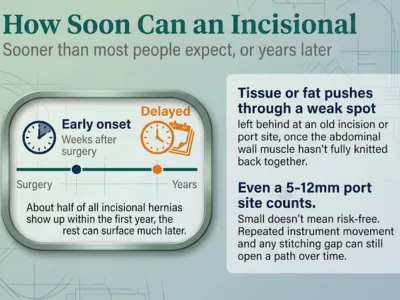
Some hernias show up early, within a few weeks, often while the wound is still tender. That’s usually down to how well the closure held right after surgery, or an infection that got in the way of proper healing.
Others take their time, sometimes literal years. Someone goes back to heavy lifting, puts on some weight, gets a bit older, loses some muscle tone along the way, and there it is. Around half show up within that first year. The rest wait. Which is exactly why a new bulge at an old scar is worth checking, no matter how long ago the surgery happened.
When to Seek Immediate Medical Care
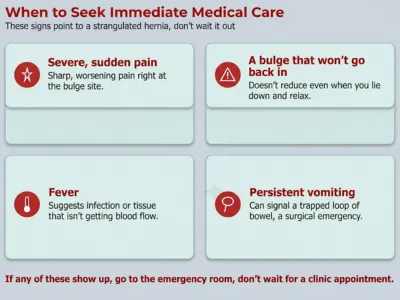
A hernia turns into a genuine emergency when the bulge gets trapped and either loses its blood supply (strangulation) or blocks the bowel. It’s rare. But it’s serious enough that everyone should know the warning signs.
- Severe pain, sudden or rapidly getting worse
- A bulge that won’t push back in, even lying down and fully relaxed
- Fever
- Persistent vomiting, or trouble passing gas or stool
If a few of these show up together, don’t sit on it. Get to an emergency room.
How Is an Incisional Hernia Diagnosed?
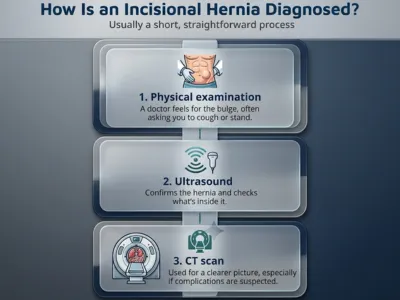
It generally starts with a physical exam. Your doctor feels for the bulge, maybe asks you to cough or stand so it shows itself more clearly. If that’s not quite enough, or if surgery’s being considered, imaging fills in the rest.
- Physical exam, usually the first and most telling step
- Ultrasound, confirms the hernia and shows what’s inside it
- CT scan, for a sharper picture, especially if complications are suspected
Treatment Options
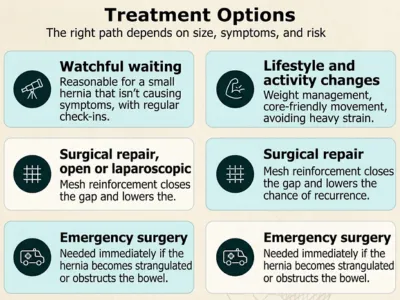
What happens next depends on size, symptoms, and how quickly things are changing. There’s genuinely no single answer that fits every patient here.
- Watchful waiting, reasonable for a small hernia with no symptoms, checked periodically
- Lifestyle changes, weight management, easing off heavy strain
- Surgical repair, open or laparoscopic, usually reinforced with mesh to lower the odds of it coming back
- Emergency surgery, immediate, for a strangulated hernia or a bowel obstruction
Recovery After Incisional Hernia Repair
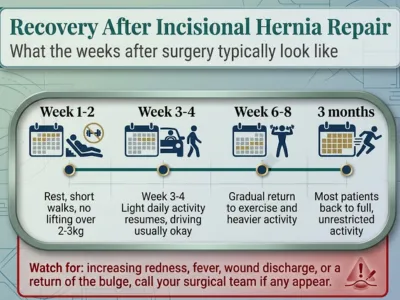
Most patients are up and walking the same day, or the next. Getting back to full strength takes longer than that, and rushing it is usually how a repair ends up failing a second time.
- Weeks 1 to 2: rest, short walks, nothing heavier than a light bag
- Weeks 3 to 4: light daily activity, driving is usually fine by now
- Weeks 6 to 8: gradually easing back into exercise
- Around 3 months: most people are back to full, unrestricted activity
Keep an eye out for spreading redness, fever, wound discharge, or the bulge coming back. Any of those, call your surgical team. Don’t wait for your next scheduled visit.
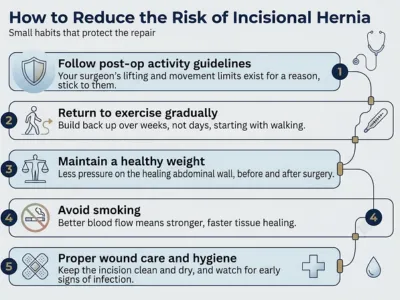
How to Reduce the Risk of Incisional Hernia
- Stick to your surgeon’s activity limits, they’re set for a reason
- Build back into exercise over weeks, not days
- Keep your weight in a healthy range, it eases pressure on the healing wall
- Skip the cigarettes, nicotine slows healing more than people realise
- Keep the wound clean and dry, and watch for early signs of infection
FAQ
How common is incisional hernia after laparoscopic surgery?
Uncommon, usually under 5%, well below the 20% seen after open surgery.
Which laparoscopic surgeries carry the highest risk?
Ones with bigger ports: gallbladder removal, bariatric, and colorectal surgery top the list.
How long after surgery can it develop?
Weeks to years. Roughly half show up within the first year.
Can a small hernia heal without surgery?
Not on its own, the gap doesn’t close by itself, but small, symptom-free ones can often just be watched.
What does the bulge actually feel like?
Soft, sometimes tender, more noticeable standing or straining, and it tends to flatten out lying down.
References
- Incisional Hernia Rates After Laparoscopic or Open Abdominal Surgery, Systematic Review and Meta-Analysis, PubMed
- Incidence and Prevention of Ventral Incisional Hernia, ScienceDirect
- Incisional Hernia Rate After Laparoscopic Colorectal Resection, PMC, National Library of Medicine
- Incisional Hernia, StatPearls, NCBI Bookshelf, National Library of Medicine
- Strangulated Hernia, StatPearls, NCBI Bookshelf, National Library of Medicine