
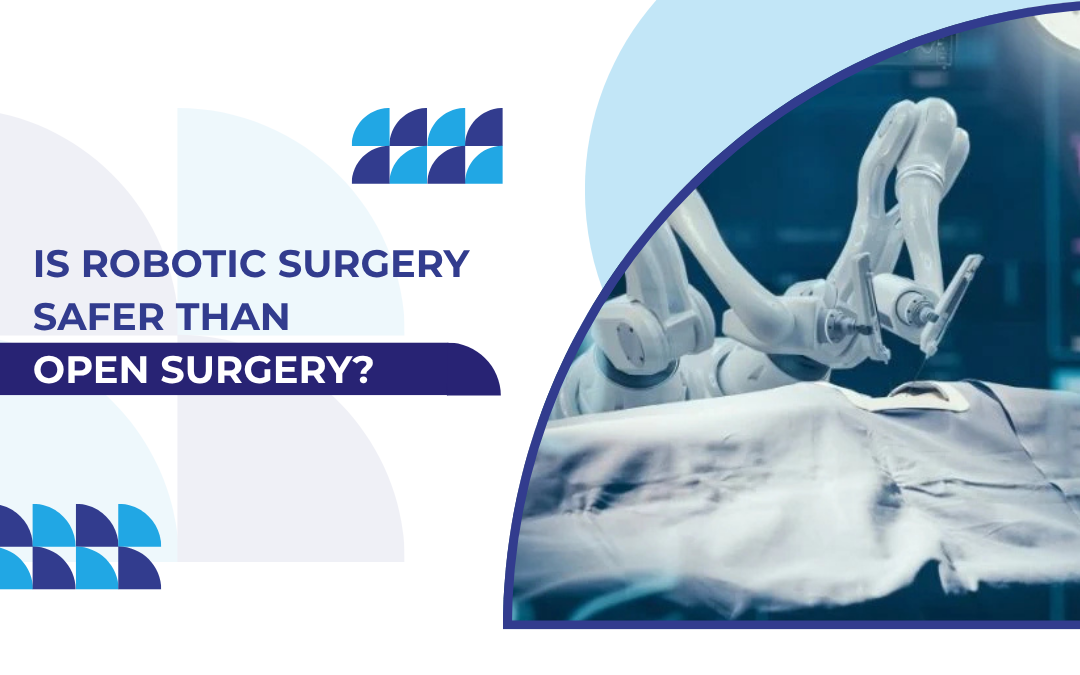
Robotic surgery is a minimally invasive technique where a surgeon operates through small incisions using robotic arms guided from a console, offering greater precision in confined anatomical spaces compared to conventional open surgery.
According to the Surgeons at Echelon Hospital, a multispecialty hospital in Kopar Khairane, “Robotic surgery gives us better control in tight spaces, but it’s not the right choice for every case. Open surgery still has clear advantages in emergencies and complex anatomy, and choosing between them is a clinical decision, not a technology preference.”
How Does Robotic Surgery Work and How Does It Differ From Open Surgery?
The two approaches differ significantly in how they access the body, what the surgeon can see, and how the patient recovers.
- The surgeon works from a console a short distance away, guiding robotic arms through a few small cuts. A 3D camera magnifies the operative field, and the system filters out natural hand tremor, especially useful in tight spaces like the pelvis, chest, or throat.
- Open surgery uses one larger incision for direct hands-on access. When there’s uncontrolled bleeding, a large tumour, or heavy abdominal scarring from past operations, that direct access is often the safest and most practical route.
- Three to five small cuts heal faster than one long one. Patients generally have less pain, lower infection risk, and get home sooner after a robotic procedure than after an equivalent open one.
- The robotic arms have no independent function. Every movement comes from the surgeon’s hands at the console. The system simply scales and steadies what the surgeon does; there’s no automation involved.
This precision and faster recovery is a major reason robotic platforms are now used in select cardiac surgery cases, where operating in a confined chest cavity benefits from the added control.
Considering surgery and want to know your options?
When Is Robotic Surgery the Right Choice and When Is Open Surgery Still Better?
The clinical picture determines the approach — the condition, the anatomy, the patient’s history. What equipment is available doesn’t factor into it.
- Prostatectomy, hysterectomy, myomectomy, colorectal resection, bariatric surgery, cardiac valve repair, and certain head and neck procedures are among the cases where robotic precision in a confined space tends to make a real difference to outcomes.
- Bleeding that needs immediate direct control, tumours too large for port access, and dense scarring from previous abdominal operations are situations where open surgery is simply the more practical choice.
- Laparoscopy had already moved many procedures away from open surgery before robotic systems became widely available. It uses small cuts and a camera without the robotic platform, and robotic surgery builds on it rather than replacing it across the board.
- Body weight, prior surgical history, cardiovascular tolerance for longer anaesthesia, and how far the condition has progressed all shape what the surgeon actually recommends for that individual patient.
Knowing what a major open procedure involves puts this comparison in clearer perspective. Reading about what open heart surgery requires explains why minimally invasive access is preferred whenever anatomy allows.
Why Choose Echelon Hospital for Surgical Care in Kopar Khairane
Echelon Hospital is a NABH pre-accredited multispecialty hospital in Kopar Khairane, Navi Mumbai. The surgical team covers general surgery, cardiothoracic, gynaecology, urology, and bariatric procedures, with both minimally invasive and open options on the table. Every recommendation goes through a proper pre-operative workup condition, fitness, recovery expectations before anything is decided.
FAQ
Is robotic surgery performed by a robot or a surgeon?
A surgeon controls every movement at the console in real time the arms don’t act on their own.
Does robotic surgery carry more risk than open surgery?
The anaesthetic and surgical risks are broadly similar, but robotic cases tend to involve less blood loss and fewer wound issues for the right patients.
Is robotic surgery available for all operations?
Not at all — it’s best established in urology, gynaecology, colorectal, bariatric, and thoracic work, and plenty of conditions aren’t suitable for it.
How does recovery compare to open surgery?
Most robotic patients are mobile within a day or two and home within the week. Open procedures often mean four to six weeks before full recovery.
Is robotic surgery more expensive?
The equipment and training push costs up, though a shorter hospital stay does offset some of that for most patients.
References:
- Advancements in Robotic Surgery: A Comprehensive Overview — PMC, National Library of Medicine: https://pmc.ncbi.nlm.nih.gov/articles/PMC10784205/
- Robotic Surgery: A Narrative Review — PMC, National Library of Medicine: https://pmc.ncbi.nlm.nih.gov/articles/PMC9573327/
Disclaimer: This blog is for educational purposes only and is not a substitute for professional medical advice. Please consult a qualified doctor for guidance specific to your case.