
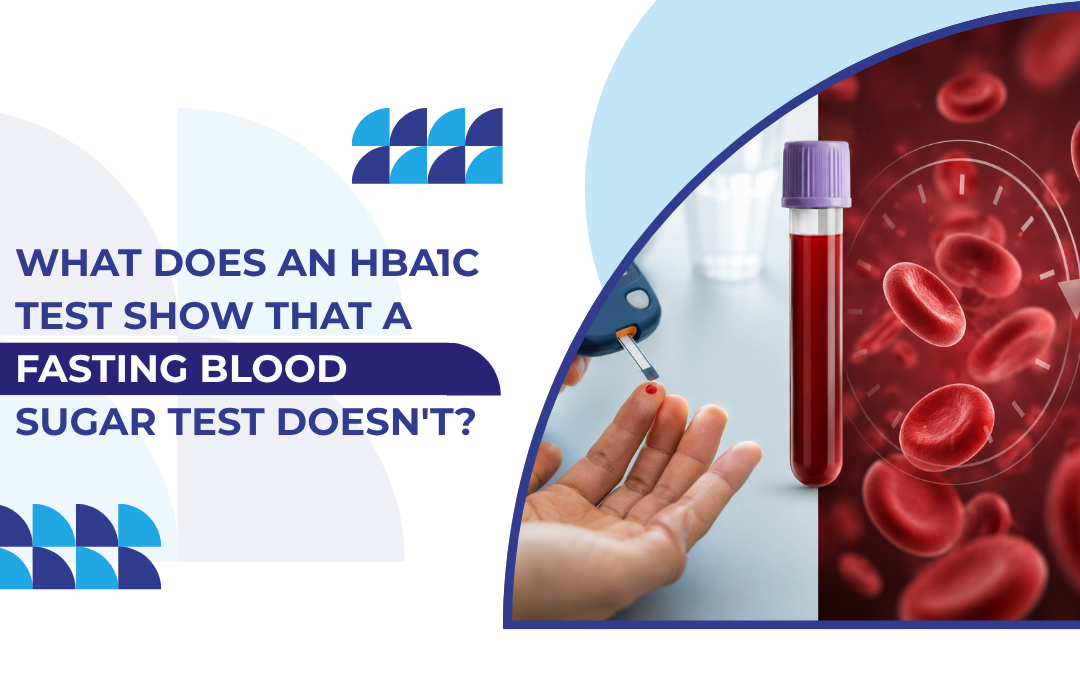
Think of a fasting blood sugar test as a single photograph, a snapshot of your glucose level the moment the blood is drawn. An HbA1c test works more like a two to three month video, tracking the average sugar level over that stretch instead of one isolated reading. Both fall under the umbrella of a diabetes test, but they’re really answering two different questions. Knowing which one your doctor is actually asking for can save a lot of confusion at the lab.
According to the senior endocrinologist at Echelon Hospital, a super speciality hospital in Navi Mumbai, “Patients often bring in a normal fasting sugar reading and assume everything’s fine, and sometimes it is. But a single good morning doesn’t rule out sugar spikes the rest of the day. That’s exactly where HbA1c fills the gap. It shows the pattern, not just one snapshot.”
What Does Each Test Actually Measure?
Both are blood sugar tests on paper. The similarity ends there.
Fasting blood sugar: taken after roughly eight hours without food, this test captures glucose levels at one exact moment, nothing more.
HbA1c: measures how much sugar has attached itself to hemoglobin over the two to three month life of a red blood cell. A slower, steadier picture.
Why timing matters: a fasting reading can swing from normal to high within a day or two. HbA1c doesn’t swing like that, since it’s averaging months, not moments.
Prep required: fasting sugar demands, unsurprisingly, fasting. HbA1c asks for none of that, which is part of why labs lean on it so heavily for screening.
Managing blood sugar over the long run rarely comes down to one test result. That’s usually where structured diabetes and endocrinology care actually makes the difference.
Not sure which diabetes test you actually need?
HbA1c vs Fasting Blood Sugar, Which One Do You Actually Need?
There’s no universal answer here, it depends entirely on what the test is trying to find out.
For diagnosing diabetes: many doctors run both, since each test can miss something the other one catches on its own.
For tracking existing diabetes: HbA1c tends to be the preferred option, given it reflects months of control rather than a single day’s number.
For quick screening: fasting blood sugar wins on speed and cost, useful as a first pass before anyone decides more testing is needed.
For borderline results: HbA1c often clears things up, because one unusually good or bad fasting number isn’t always something to trust blindly.
Recognising these patterns early carries real weight. This related read on early symptoms of Type 2 diabetes covers signs that often get brushed off long before a diagnosis is even on the table.
Why Choose Echelon Hospital for Diabetes Testing?
Echelon Hospital is a NABH pre accredited multispecialty hospital in Kopar Khairane, with an in-house lab running both fasting sugar and HbA1c tests without sending patients elsewhere for a referral. Its diabetes and endocrinology team reviews most results the same day, so a borderline reading doesn’t sit unexplained for a week while everyone waits.
For patients unsure which diabetes test actually fits their situation, having lab work and specialist consultation in one place means the right test gets ordered from the start. Call +91 8989585050 to book your consultation.
FAQ
Is HbA1c more accurate than fasting blood sugar?
Not more accurate, just measuring something different, an average versus a moment.
Do I need to fast before an HbA1c test?
No, HbA1c can be taken at any time of day.
Can HbA1c be normal while fasting sugar is high?
Yes, occasionally, which is why doctors often check both.
How often should HbA1c be tested?
Typically every three to six months for those managing diabetes.
References
- MedlinePlus, Hemoglobin A1c (HbA1c) Test: https://medlineplus.gov/lab-tests/hemoglobin-a1c-hba1c-test/
- American Diabetes Association, Understanding A1C: https://diabetes.org/about-diabetes/a1c
Disclaimer: This blog is for educational purposes only and is not a substitute for medical advice. Please consult your doctor to determine which diabetes test is right for you.