
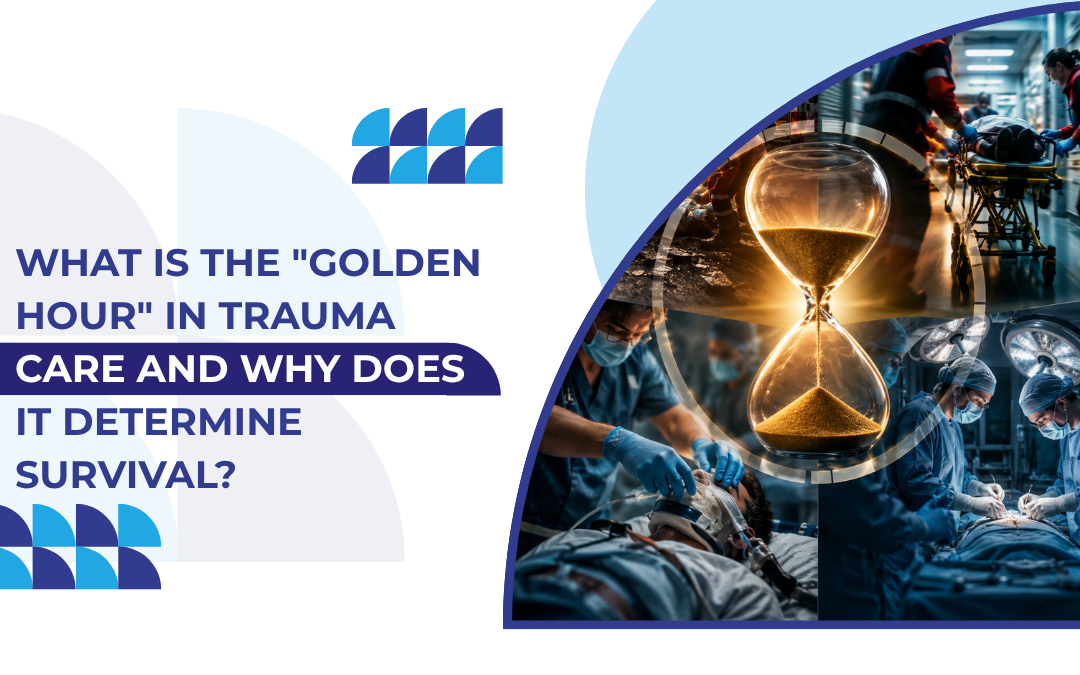
Sixty minutes. That’s roughly how long doctors have to work with after a severe injury before the odds start tilting the wrong way. It’s called the golden hour, and it’s the narrow window where fast medical and surgical care gives a patient the strongest shot at survival. Every minute lost inside that window raises the risk of shock, organ failure, and death. So speed matters here more than almost anything else in trauma response. Understanding golden hour trauma care changes how people react in the moments right after an accident.
According to a senior trauma physician at Echelon Hospital, “people underestimate how fast the body decompensates after major trauma, and that’s the real danger. A patient can look stable one moment and crash the next. We see it constantly. Delayed transport. Wasted time deciding where to go. A minor injury mistaken for something the body can wait out. My honest take? Don’t drive around looking for the nearest clinic. Get to a trauma centre. Every minute inside that first hour works in the patient’s favor, and every minute lost works against them.”
What Happens During the Golden Hour?
The golden hour isn’t one single action. It’s a sequence, and each step depends on the one before it moves fast.
Initial assessment: airway, breathing, and circulation get checked first, since these three determine what happens next more than anything else.
Bleeding control: major blood loss is addressed immediately, often before a full diagnosis is even complete. Blood loss alone can be fatal within minutes.
Imaging and diagnosis: CT scans and X-rays identify internal injuries that aren’t visible from the outside, guiding the surgical team toward what actually needs fixing.
Surgical intervention: for injuries needing immediate correction, operating rooms are already staffed and ready. Trauma cases rarely wait for a scheduled slot.
Every one of these steps depends on speed. And that’s precisely why proper critical care support is built around round the clock readiness rather than a slower, case by case response.
Dealing with a severe injury right now? Get emergency medical care immediately.
Why Does the Golden Hour Determine Survival?
Time and injury severity interact in a way that isn’t intuitive until you understand what’s happening inside the body.
Shock sets in fast: blood pressure drops as the body struggles to compensate for blood loss, and shock becomes harder to reverse the longer it goes untreated.
Organ failure risk climbs: organs starved of oxygen and blood flow begin failing within the hour, and some of that damage doesn’t reverse even after treatment starts.
Delayed care compounds injury: a wound that’s manageable at minute ten becomes far more dangerous at minute fifty. The underlying damage keeps progressing the entire time.
Trauma centre access matters: patients treated within the golden hour at a fully equipped facility have significantly better outcomes than those treated later or at under equipped facilities.
Recognising when a patient needs escalated monitoring matters just as much once the golden hour has passed. This related read on when a patient is shifted to the ICU covers what comes after initial trauma stabilisation.
Why Choose Echelon Hospital for Trauma Care?
Echelon Hospital has built its emergency infrastructure around one basic reality: trauma cases don’t wait for convenient timing. Its trauma and critical care teams are staffed around the clock, with imaging, operating rooms, and specialist coverage available the moment a patient arrives, not after a delay to assemble the right team.
Trauma rarely involves just one system of the body, so cases move quickly between orthopaedic, neuro, and general surgery as needed, rather than being handled by a single department working in isolation. In a trauma emergency, call the ambulance line at +91 9326017389, or reach the Health Line at +91 8989585050 for immediate guidance.
FAQ
What is the golden hour in trauma care?
It’s the first sixty minutes after a severe injury, the window when quick treatment has the greatest impact on survival.
Why is speed so critical after a major injury?
Because shock and organ failure progress rapidly the longer treatment is delayed.
Should I drive an injured person to the hospital myself?
An ambulance is safer, since care can begin before arrival.
Does the golden hour apply to all injuries?
It applies most to severe, life-threatening injuries, not minor ones.
References
- American College of Surgeons — Trauma Care Standards: https://www.facs.org/quality-programs/trauma/quality/verification-review-and-consultation-program/standards/
- WHO — Injuries and Violence: https://www.who.int/news-room/fact-sheets/detail/injuries-and-violence
Disclaimer: This article is for general awareness only and does not replace professional medical advice. In an emergency, call for immediate medical help.