
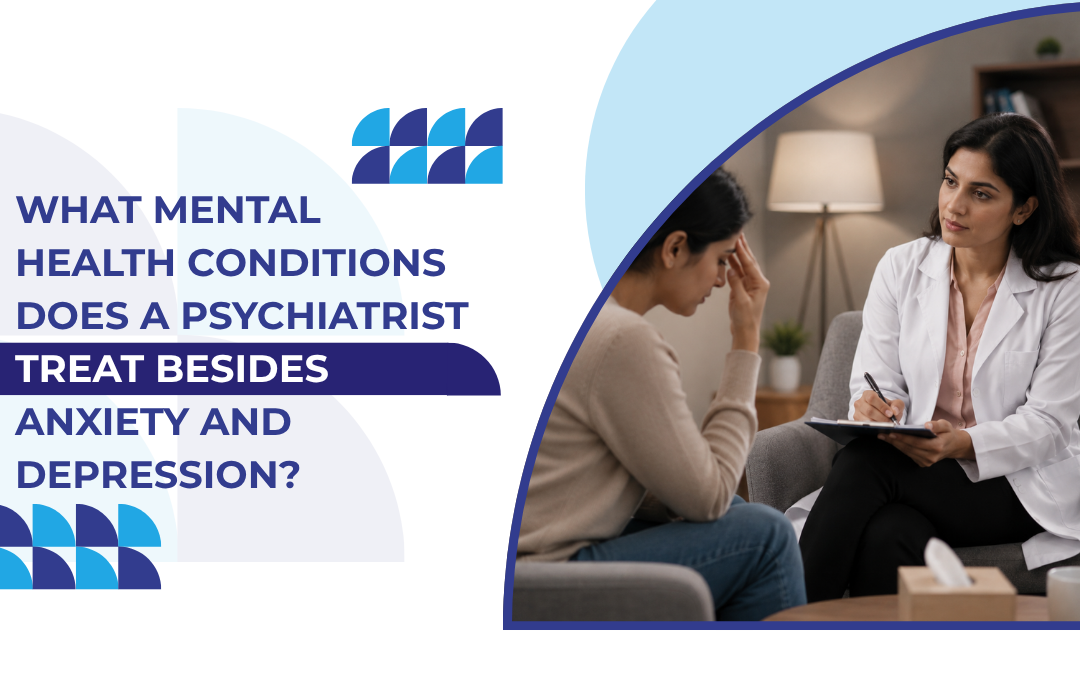
People usually name two things when asked what a psychiatrist treats. Anxiety. Depression. That’s the whole list in most heads. But it’s nowhere close to the real one. Psychiatrists are doctors, actual medical doctors, and they handle a much wider spread of conditions using evaluation, medication, and therapy together. Knowing what’s actually on that list, the conditions treated by a psychiatrist, changes when someone finally books the appointment they’ve been putting off.
According to the senior psychiatrist at Echelon Hospital, a super speciality hospital in Navi Mumbai, “Anxiety and depression, sure, those come up a lot. But they’re not even close to everything we see day to day. Bipolar disorder, OCD, Adult ADHD, Eating disorders, Psychotic conditions, Personality disorders. Each one needs its own approach, rather than a generic label.”
Which Conditions Does a Psychiatrist Treat Beyond Anxiety and Depression?
Mood disorders get all the attention. That’s fair, they’re common. But they’re not the whole picture.
Bipolar disorder: Swings between depressive lows and manic or hypomanic highs. Mood stabilizers plus therapy, that’s usually the combination that keeps it steady.
Obsessive Compulsive Disorder (OCD): Intrusive thoughts on repeat, paired with compulsions meant to quiet them down. Specific therapy techniques and medication together tend to work best.
Adult ADHD: Doesn’t just vanish after childhood. Plenty of adults get diagnosed for the first time in their thirties, forties, sometimes later.
Eating disorders: Anorexia, bulimia, these carry real physical risk alongside the psychological challenges. A psychiatrist working with a nutritionist is often the actual setup.
A proper evaluation through psychiatry care is really the first move, since a lot of these look like anxiety or depression at first glance.
Wondering if your symptoms fall under a psychiatrist’s care?
When Should You See a Psychiatrist Instead of a Therapist?
Not every mental health issue needs the same level of help.
Symptoms affecting daily functioning: Work falling apart. Relationships fraying. Routines collapsing. That’s usually the sign it’s time for a psychiatric evaluation, not just another wait and see.
Need for medication evaluation: Psychiatrists can prescribe. Therapists can’t. So for conditions where biology is doing a lot of the work, that distinction matters.
Suspected psychotic symptoms: Hallucinations. Delusions. Any real break from reality. Go get assessed. Therapy alone isn’t built for this.
Conditions with a strong biological component: Bipolar disorder, schizophrenia, these lean hard on medical management. Talking helps. It doesn’t rewrite the underlying biology by itself.
Figuring out whether therapy or medication fits a specific case, that’s exactly the call a psychiatric evaluation is meant to make.
Why Choose Echelon Hospital for Psychiatric Care?
Echelon Hospital is a NABH pre accredited multispecialty hospital in Kopar Khairane, and the psychiatry team here handles diagnoses that go well past anxiety and depression. Finding the right psychiatrist matters most when nothing fits a tidy category. A proper evaluation is what sorts that out, not a guess.
Call +91 8989585050 to book a consultation.
FAQ
Can adults be diagnosed with ADHD for the first time?
Yes, adults are commonly diagnosed with ADHD, sometimes decades after childhood.
What conditions besides anxiety and depression need a psychiatrist?
OCD, eating disorders, bipolar disorder, and psychotic disorders all need one.
When should someone see a psychiatrist over a therapist?
Usually when medication, biological factors, or diagnosis clarity are needed.
Can psychiatrists prescribe medication?
Yes, psychiatrists can prescribe medication, unlike most other mental health professionals.
References
- NIMH, Mental Illness: https://www.nimh.nih.gov/health/statistics/mental-illness
- WHO, Mental Disorders Fact Sheet: https://www.who.int/news-room/fact-sheets/detail/mental-disorders
Disclaimer: This blog is for educational purposes only and does not constitute medical advice. Please consult a psychiatrist for diagnosis and treatment.