
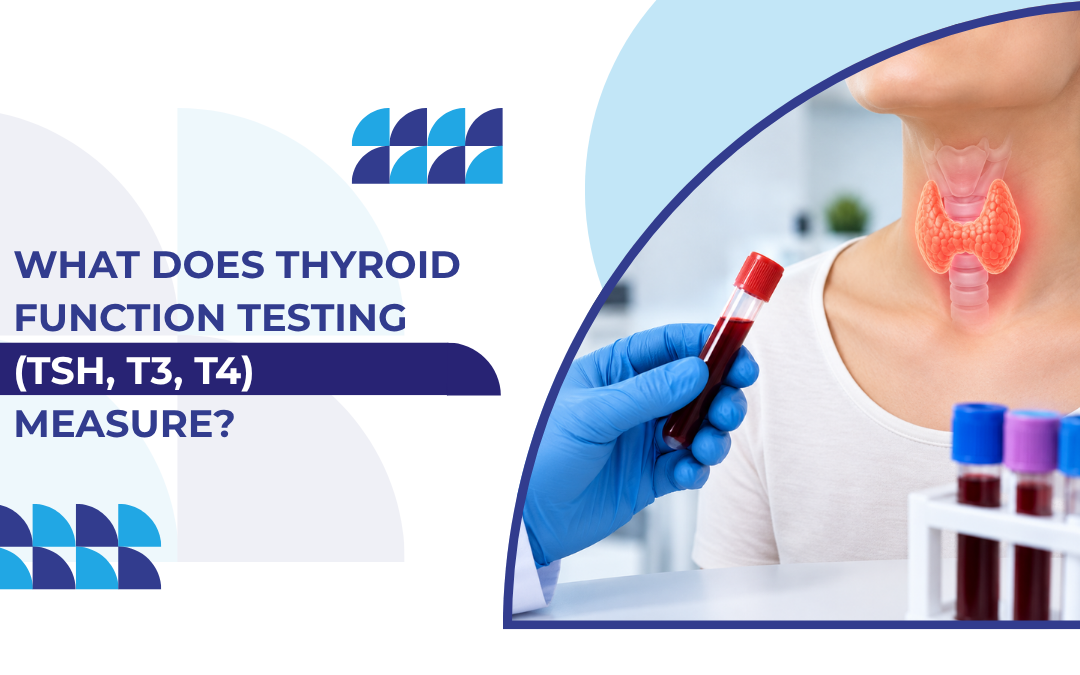
Blood work is how a thyroid function test works, pulling out hormone levels that reveal whether the gland is running as it should. Doctors lean on it heavily when hypothyroidism or hyperthyroidism is suspected. Three separate markers make up the panel, TSH, T3, and T4, and none of them tells the full story alone. Put together, though, they’re what turns a vague thyroid concern into an actual diagnosis.
According to the senior endocrinologist at Echelon Hospital, a multi-specialty hospital in Navi Mumbai, “TSH tells us what the pituitary gland thinks the thyroid should be doing. T3 and T4 tell us what the thyroid is actually producing. Reading TSH alone can miss the full picture, especially in early or borderline cases.”
What Do TSH, T3, and T4 Each Measure?
No single marker on this panel does all the work, which is exactly the point.
- TSH: The pituitary gland releases TSH to tell the thyroid to ramp production up or down. Because it reacts early to imbalance, doctors reach for it first, often before a patient notices any symptoms at all.
- T4: Thyroxine, the thyroid’s main output. Most of what circulates stays bound to carrier proteins, leaving only a sliver of it free to actually reach and affect cells.
- T3: Triiodothyronine is the version that does the real work at a cellular level, mostly formed when tissues convert T4. Certain thyroid disorders show a shift in T3 before T4 moves at all.
- Why Order All Three: TSH by itself can miss a case sitting right on the border. Pairing it with T3 and T4 closes that gap.
Making sense of these three results together is an important part of diabetes and endocrinology care, as no single result tells the whole story.
Wondering what your own thyroid test results actually mean?
When Should You Get a Thyroid Function Test?
Certain red flags send patients toward this specific blood panel more than others.
- Weight Shifting for No Clear Reason: Gaining or losing without changing diet or activity is a classic reason doctors reach for this test.
- Energy Behaving Strangely: Constant fatigue on one end, restless overdrive on the other, both point back to the thyroid as a possible cause.
- Heart Rate or Mood Acting Off: A pulse running too fast or too slow, paired with mood swings that don’t fit the person, is enough to warrant a check.
- Planning Pregnancy, or a Family History of Thyroid Issues: Both scenarios push doctors to test early rather than wait for symptoms to surface.
Thyroid function and blood sugar regulation are closely connected, so it’s worth understanding how HbA1c and fasting blood sugar differ if metabolic screening is happening alongside a thyroid panel.
Why Choose Echelon Hospital for Your Thyroid Function Test?
Echelon Hospital is a NABH pre accredited multispecialty hospital in Kopar Khairane, with an in house lab and endocrinology team that review TSH, T3, and T4 results together rather than as isolated numbers. For anyone searching for an endocrinologist near me, having testing and consultation under one roof means results are explained the same day, not left for a follow up call.
Call +91 8989585050 to book a consultation.
FAQ
Which of the three tests comes back first, typically?
TSH is usually checked first, since it tends to flag issues earliest.
Is fasting required before this blood work?
No fasting is required, thyroid tests only need a routine blood sample.
Will this panel catch an overactive as well as an underactive thyroid?
Yes, both conditions are diagnosed through this same thyroid function panel.
What's the usual gap between retests once treatment starts?
Retesting every six to twelve weeks is typical until levels stabilize.
References
- MedlinePlus, Thyroid Function Tests: https://medlineplus.gov/ency/article/003444.htm
- NIDDK, Thyroid Tests: https://www.niddk.nih.gov/health-information/diagnostic-tests/thyroid
Disclaimer: This blog is for educational purposes only and does not constitute medical advice. Please consult your doctor to interpret your thyroid test results.