
IVF Treatment to Help a Couple Conceive After Years of Trying to Get Pregnant
A 34-year-old woman and her husband had been trying to conceive for six years without success, undergoing multiple failed treatment cycles elsewhere before coming to Echelon Hospital. After a thorough fertility work-up, the IVF team identified the underlying cause and designed a customised IVF protocol at this best hospital in Navi Mumbai. The couple conceived successfully in their first IVF cycle at Echelon, and the pregnancy progressed without complications.
PATIENT PROFILE
| Name | Anjali and Rohan Kulkarni (names changed for privacy) |
| Age | 34 years (wife), 37 years (husband) |
| Gender | Female and Male (couple) |
| Occupation | Teacher and IT professional |
| Chief Complaint | Unable to conceive naturally for 6 years |
| Affected Area | Reproductive system (combined factor infertility) |
| Diagnosis | Diminished ovarian reserve with mild male factor infertility |
| Previous History | Two prior failed IUI cycles, no successful pregnancy |
| Date of Treatment | March 2026 |
| Outcome | Excellent |
Name changed for privacy. Case published with patient consent.
THE PROBLEM
Six years, two failed IUI attempts, and countless difficult conversations. By the time they came to Echelon, they had almost stopped hoping.
Anjali and Rohan had been married for seven years and trying to conceive for six of them. They had undergone two intrauterine insemination cycles at another clinic, both unsuccessful, and had been advised to consider IVF but had not pursued it due to uncertainty about their chances of success. They came to Echelon Hospital’s IVF unit seeking a fresh, thorough evaluation before deciding on their next step.
A detailed fertility work-up was carried out for both partners. Anjali’s ovarian reserve testing showed a lower than expected AMH level for her age, indicating diminished ovarian reserve. Her fallopian tubes were patent and her uterine cavity was normal on hysteroscopy. Rohan’s semen analysis showed mildly reduced sperm motility, a contributing factor that had likely lowered the success rate of their earlier IUI attempts. Individually, neither factor was severe, but combined, they explained years of unsuccessful natural and assisted attempts. The fertility team explained that with diminished ovarian reserve and a male factor present, IVF with intracytoplasmic sperm injection offered a significantly better chance of success than repeating IUI. Couples in this situation often ask why IVF succeeds where IUI hasn’t, and the answer usually lies in bypassing exactly the barriers that repeated simpler treatments could not overcome.
Difficulty conceiving after a year of trying, or after 6 months for women over 35, is worth a proper fertility evaluation rather than more time spent waiting.
CONSULTATION AND TREATMENT PLAN
“After years of failed attempts, couples come to us carrying a lot of disappointment. Our job isn’t just to run another cycle, it’s to actually understand why previous treatments didn’t work and change the approach accordingly. For this couple, that meant addressing both the ovarian reserve and the sperm factor together, not treating them as separate problems.”
– IVF Team, IVF Treatment, Navi Mumbai
Assessment findings
- AMH level indicating diminished ovarian reserve in the wife
- Fallopian tubes patent, uterine cavity normal on hysteroscopy
- Semen analysis showing mildly reduced sperm motility in the husband
- Two previous IUI cycles unsuccessful, no prior IVF attempted
- Baseline hormonal profile and ultrasound scan completed before stimulation
- Combined factor infertility identified as the reason for delayed conception
- Couple counselled on ICSI as part of the IVF protocol
Why IVF with ICSI
When both diminished ovarian reserve and reduced sperm motility are present, simpler treatments like IUI rely on natural fertilisation happening inside the body, which becomes less likely as both factors compound each other. IVF removes several of these barriers by retrieving eggs directly and combining them with sperm under controlled laboratory conditions. Intracytoplasmic sperm injection, where a single healthy sperm is injected directly into each egg, was recommended given the mild male factor, to maximise the chance of fertilisation. For Anjali and Rohan, this combined approach addressed both underlying issues in a single, carefully monitored cycle rather than treating one factor at a time.
The full protocol was discussed with the couple in detail, including the stimulation process, egg retrieval, fertilisation method, and embryo transfer, along with realistic expectations for success rates at their age and diagnosis.
| Procedure | IVF with Intracytoplasmic Sperm Injection (ICSI) |
| Protocol Used | Antagonist stimulation protocol |
| Eggs Retrieved | 9 |
| Embryos Formed | 5 |
| Embryo Transferred | Single blastocyst, day 5 |
| Anaesthesia | Short general anaesthesia (for egg retrieval only) |
| Complications | None |
Struggling to conceive and unsure what step to take next?
PROCEDURE DETAILS
1. Baseline hormonal and ultrasound assessment completed before starting stimulation
2. Controlled ovarian stimulation started with daily injectable hormone medication
3. Follicular growth monitored through repeated ultrasound scans and blood tests
4. Trigger injection administered once follicles reached optimal size
5. Egg retrieval performed under short general anaesthesia, 9 eggs collected
6. Sperm sample collected and prepared from the husband on the same day
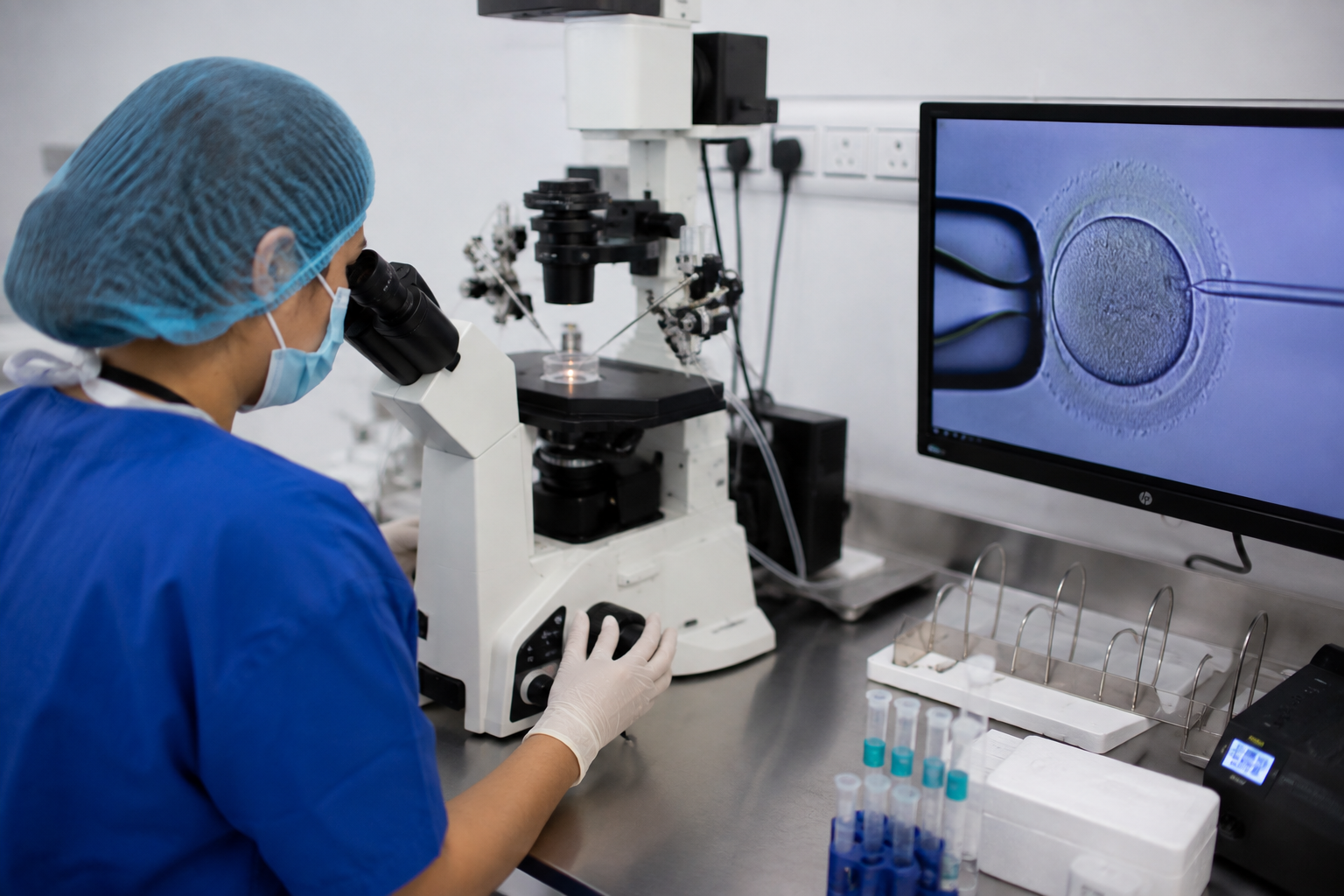
7. ICSI performed, injecting a single sperm directly into each mature egg
8. Fertilised eggs cultured in the laboratory and monitored for development
9. Embryos graded on day 5; the best quality blastocyst selected for transfer
10. Single embryo transferred into the uterus under ultrasound guidance; remaining embryos frozen
POST TREATMENT CARE AND RECOVERY
The two weeks after embryo transfer are the hardest to wait through. Clear guidance and steady support through this period matter as much as the medical protocol itself.
Immediate post-transfer care
- Mild rest advised for 24 to 48 hours after embryo transfer, though strict bed rest is not required
- Progesterone support continued to help sustain the uterine lining
- Avoid strenuous exercise and heavy lifting during the two-week wait
- Blood test scheduled 14 days after transfer to confirm pregnancy
Everyday care during early pregnancy
- Continue prescribed hormonal support until advised to stop by the fertility team
- Avoid self-medicating for minor symptoms without checking with the team first
- Attend the first pregnancy ultrasound as scheduled to confirm location and viability
- Maintain a balanced diet and stay adequately hydrated
When to call the hospital
Contact the hospital immediately in case of heavy bleeding, severe abdominal pain, fever, or symptoms of ovarian hyperstimulation such as bloating and breathlessness after egg retrieval. Regular follow-up through the beta hCG test, first ultrasound, and handover to antenatal care is essential to a smooth ongoing pregnancy.
RESULTS
PATIENT FEEDBACK
Shared after their first successful ultrasound. Their own words. A – Anjali Kulkarni (name changed for privacy) • Verified Patient • Echelon Hospital ★★★★★ March 2026
“After six years and two failed IUIs, we had lost a lot of hope. The team at Echelon actually took the time to find out why it wasn’t working before starting IVF. When we saw the heartbeat on the scan, we both cried in the room. We are so thankful for how honestly and carefully they guided us.”
Procedure: IVF with ICSI • Combined Factor Infertility • Echelon Hospital • March 2026 • Google Review • Published with written consent
WHY CHOOSE ECHELON HOSPITAL
Echelon Hospital approaches fertility treatment as a diagnostic process first and a procedure second. For Anjali and Rohan, that meant a fresh, detailed evaluation of both partners rather than repeating what had already failed elsewhere, and a protocol built specifically around what that evaluation found. The IVF team works closely with the hospital’s diagnostic laboratory, ultrasound services, and obstetrics department, so that once a pregnancy is confirmed, care continues seamlessly without the couple needing to start over with a new team. This continuity, from first consultation through to a confirmed heartbeat, is what Echelon aims to offer every couple navigating infertility.
Health Line: +91 89895 85050
Talk to our IVF team about your fertility concerns.
FAQs
Q1. When should a couple consider IVF instead of IUI?
IVF is usually recommended when IUI cycles have failed, when there is a significant male factor, blocked fallopian tubes, diminished ovarian reserve, or when the woman is above a certain age, as IVF offers higher success rates in these situations.
Q2. What is ICSI and why is it used alongside IVF?
ICSI involves injecting a single sperm directly into an egg to assist fertilisation. It is recommended when sperm quality or motility is reduced, as it removes the need for sperm to fertilise the egg naturally in the laboratory dish.
Q3. How many IVF cycles does it usually take to conceive?
Success can happen in the first cycle, as it did in this case, but for many couples it can take more than one cycle. Age, ovarian reserve, and the underlying cause of infertility all influence the number of cycles typically needed.
Q4. What happens to embryos that are not used in the first transfer?
Good quality embryos that are not transferred are frozen and stored, and can be used in a future frozen embryo transfer cycle if needed, without repeating the full stimulation and egg retrieval process.
Q5. Is bed rest necessary after an embryo transfer?
Strict bed rest is not required after embryo transfer. Light activity is generally safe, though strenuous exercise and heavy lifting are best avoided during the two-week wait for the pregnancy test.
Disclaimer: This case study is for general information only and reflects one patient’s outcome. Results vary from person to person. It is not a substitute for a professional medical consultation. Please book an assessment to discuss your own condition.