
Spine Surgery to Relieve Leg Pain and Numbness After a Slipped Disc
A 45-year-old truck driver developed severe shooting pain down his left leg along with numbness in his foot after months of ignoring lower back discomfort. When conservative treatment failed to bring relief, he was evaluated at Echelon Hospital, where imaging confirmed a slipped disc pressing on a nerve root. The neurosurgery team performed a microdiscectomy at this best hospital in Navi Mumbai, and he returned to walking without pain within weeks.
PATIENT PROFILE
| Name | Sanjay Patil (name changed for privacy) |
| Age | 45 years |
| Gender | Male |
| Occupation | Truck driver |
| Chief Complaint | Severe shooting pain down the left leg with foot numbness |
| Affected Area | Lower back (L4-L5 disc), left leg |
| Diagnosis | Lumbar disc herniation (L4-L5) with left-sided sciatica |
| Previous History | Chronic lower back pain for 2 years, no prior spine treatment |
| Date of Treatment | April 2026 |
| Outcome | Excellent |
THE PROBLEM
Sanjay had lived with intermittent lower back pain for nearly two years, a common complaint he attributed to long hours behind the wheel. Over the past six weeks, the pain had changed character entirely, radiating from his lower back down the back of his left leg and into his foot, accompanied by a persistent tingling and numbness that made it difficult to feel the pedals while driving. Over-the-counter painkillers and rest had stopped helping.
He came to Echelon Hospital’s neurosurgery department after the pain began waking him at night. On examination, straight leg raise testing reproduced his leg pain at a low angle, and there was reduced sensation along the outer edge of his left foot, along with mild weakness in ankle movement. An MRI of the lumbar spine confirmed a herniated disc at the L4-L5 level, with the disc material compressing the adjacent nerve root. This explained both the radiating leg pain and the numbness, a pattern commonly known as sciatica. The neurosurgery team explained that while many disc herniations improve with rest, physiotherapy, and medication, the combination of progressive numbness and motor weakness in his case indicated nerve compression significant enough that a course of conservative treatment alone carried the risk of permanent nerve damage. Patients in this situation often ask whether surgery can be avoided altogether, and the honest answer depends on whether numbness and weakness are present alongside the pain, as they were here.
CONSULTATION AND TREATMENT PLAN
“Back pain alone rarely needs surgery. What changes the picture is when a patient starts losing sensation or strength, because that tells us the nerve itself is under real pressure. In Sanjay’s case, the numbness and the weak ankle movement together meant we couldn’t just keep waiting and hoping it would settle on its own.”
– Neurosurgery Team, Neurosurgery, Navi Mumbai
Assessment findings
- Radiating pain from lower back down the left leg into the foot
- Positive straight leg raise test at a low angle on the left side
- Reduced sensation along the outer border of the left foot
- Mild weakness noted in left ankle dorsiflexion
- MRI confirmed L4-L5 disc herniation with nerve root compression
- No bladder or bowel involvement, ruling out cauda equina syndrome
- Six weeks of physiotherapy and medication had not improved symptoms
Why microdiscectomy
When a herniated disc causes progressive numbness or muscle weakness rather than pain alone, it signals that the nerve root is under sustained pressure that is unlikely to resolve with more time and conservative care. A microdiscectomy removes the portion of the disc pressing on the nerve through a small incision, relieving the compression directly. For Sanjay, whose symptoms included both sensory loss and early motor weakness, timely surgery was recommended to prevent the numbness and weakness from becoming permanent, rather than risking further nerve damage by continuing to wait.
The procedure, its minimally invasive nature, expected recovery timeline, and realistic outcomes were discussed with Sanjay in detail before he consented to surgery.
| Procedure | Lumbar Microdiscectomy (L4-L5) |
| Approach | Minimally invasive, tubular retractor system |
| Level Operated | L4-L5 |
| Anaesthesia | General anaesthesia |
| Session Type | Single surgical session |
| Complications | None |
PROCEDURE DETAILS
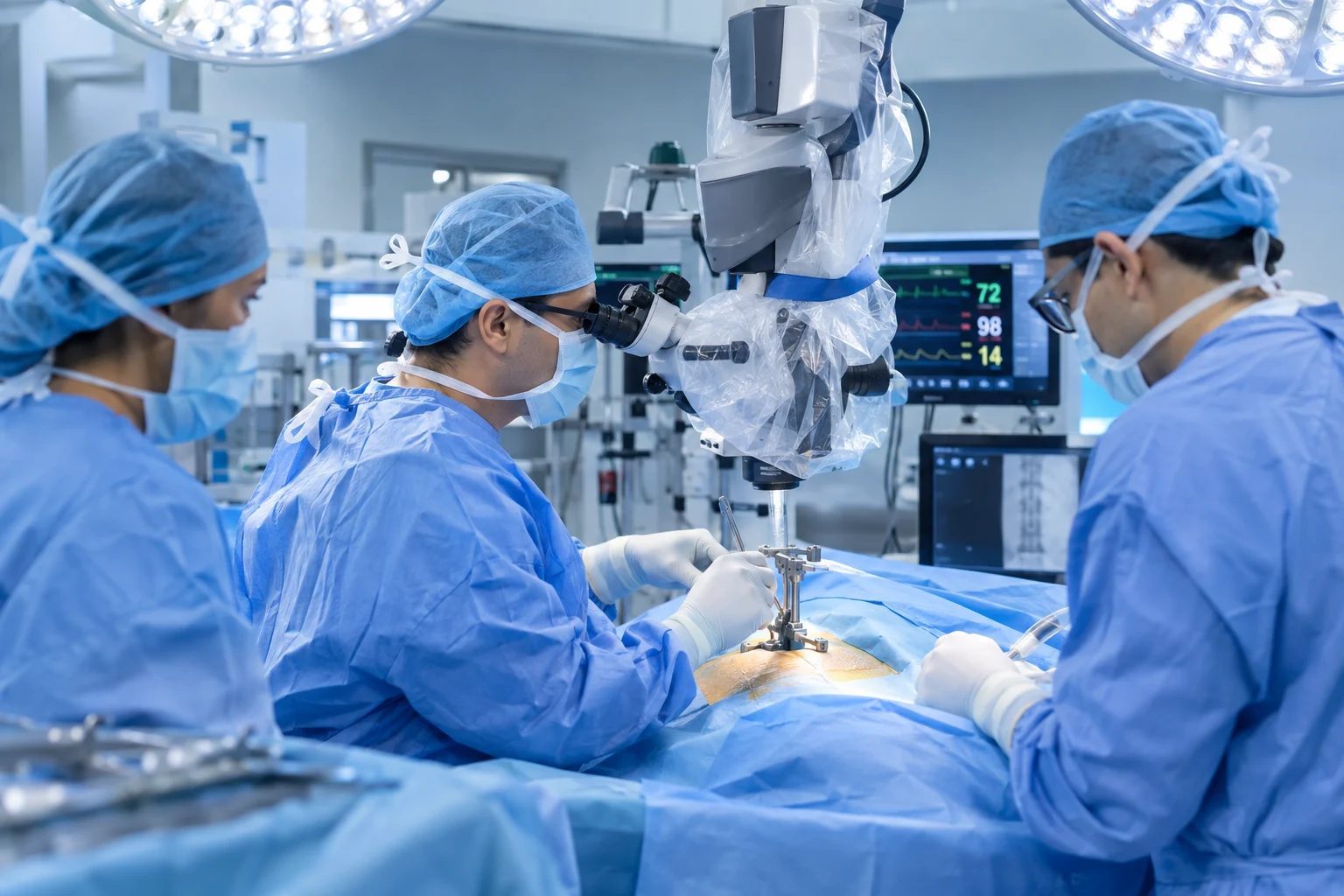
1. Pre-operative MRI review and anaesthesia assessment completed
POST TREATMENT CARE AND RECOVERY
Immediate post-operative care
● Early mobilisation encouraged within 24 hours to prevent stiffness
● Wound monitored for any signs of infection or fluid leakage
● Pain relief provided as needed, though leg pain typically eases rapidly
● Sitting and bending restricted for the first two weeks
Everyday care during recovery
● Gradual return to walking, increasing distance as comfort allows
● Avoid heavy lifting and prolonged driving for at least 4 to 6 weeks
● Structured physiotherapy started around 2 weeks to strengthen core and back muscles
● Ergonomic advice given given his occupation, particularly around seated posture
When to call the hospital
Contact the hospital immediately if there is fever, increasing wound redness or discharge, new or worsening leg weakness, or any loss of bladder or bowel control. Regular follow-up through the physiotherapy phase and the final review at three months is important to confirm complete nerve recovery.
RESULTS
PATIENT FEEDBACK
Shared at his three-month follow-up. His own words. S – Sanjay Patil (name changed for privacy) • Verified Patient • Echelon Hospital ★★★★★ April 2026
“I had ignored the back pain for so long, but when my foot went numb I got scared. The team explained why surgery was needed and not just more medicines. Within a week my leg pain was gone and now I am back to driving without any trouble. I am very grateful to the neurosurgery team at Echelon.”
Procedure: Lumbar Microdiscectomy • L4-L5 Disc Herniation • Echelon Hospital • April 2026 • Google Review • Published with written consent
WHY CHOOSE ECHELON HOSPITAL
Echelon Hospital treats spine care as a decision made carefully between surgery and conservative management, not a default path to the operating room. For Sanjay, that meant a clear explanation of why his numbness and weakness changed the risk calculation, backed by MRI findings and a hands-on neurological examination. The neurosurgery team works closely with physiotherapy and rehabilitation services, so recovery after surgery is guided under the same roof from the first post-operative day through to full return to work. This combination of careful decision-making and structured recovery is what Echelon aims to offer every patient dealing with disabling back and leg pain.
Health Line: +91 89895 85050
Talk to our neurosurgery team about your back or leg pain concerns.
FAQs
Q1. How do doctors decide if a slipped disc needs surgery?
Q2. What is a microdiscectomy and how is it different from open spine surgery?
Q3. How soon can numbness improve after disc surgery?
Q4. When can a patient return to work or driving after spine surgery?
Q5. What symptoms after spine surgery need urgent medical attention?
Disclaimer: This case study is for general information only and reflects one patient’s outcome. Results vary from person to person. It is not a substitute for a professional medical consultation. Please book an assessment to discuss your own condition.